
CASE STUDY
31 May 2024
Case study | Xiaoyuan Liu, University of Alberta, Moritz E. Kleybolte Technische Universität München, May 2024
349 nm UV laser writing in fluorescent polymer films to encode hidden information
Researchers from the University of Alberta, Technical University of Munich and collaborating institutions used a Skylark 349 NX laser to write fluorescent patterns directly into a UV-sensitive polymer.
The research explored how controlled 349 nm UV exposure changes the colour and intensity of polymer fluorescence, allowing hidden information and multi-colour patterns to be written into flexible films.
The work is relevant to researchers developing UV laser writing, fluorescent polymers, anti-counterfeiting materials, security printing and optical information storage.
Why use a 349 nm laser for polymer writing?
The polymer used in the study, MEH-PPP, absorbs strongly in the near-UV, with an absorption band around 330 nm.
The Skylark 349 NX operated at 349 nm with a nominal power of 20 - 50 mW, providing UV light within the polymer’s absorption range.
The researchers projected the 349 nm beam through a spatial light modulator, which allowed complete patterns to be written onto the polymer rather than scanning a focused beam point by point.
This made it possible to control both where the polymer was exposed and how long each region was irradiated.
Controlling fluorescence with UV exposure
The 349 nm laser was used to write the word “BLUE” into a liquid polymer film, with lettering approximately 256 µm high.
As exposure time increased, the fluorescence shifted progressively towards longer wavelengths. Shorter exposures produced green emission, while longer exposures produced yellow and orange-red emission.
The researchers used this exposure-dependent colour change to create multi-colour fluorescent patterns, including a stylised apple tree and coloured characters.
The paper also reports that irradiation at 400 nm, outside the main polymer absorption band, produced the colour-changing process much more slowly. This supports the relevance of near-UV excitation for this material system.
Writing persistent fluorescent patterns
The laser-written fluorescence patterns remained after the liquid polymer films were dried.
The researchers also demonstrated the method in flexible polymer films. Under ambient light, the written information was not visible, but under UV illumination the fluorescent pattern became clearly visible.
The films could be bent around a 90° curve, and the written patterns remained stable for at least eight weeks in air.
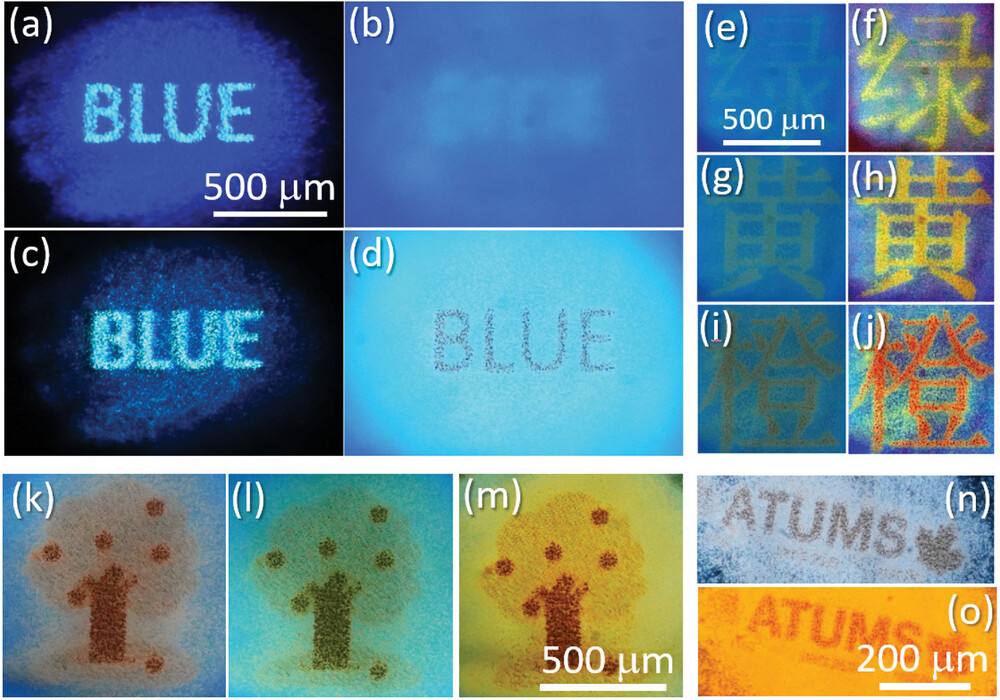
Fig. 1. Fluorescence image showing SLM laser writing in an MEH-PPP liquid film in the 50-50 mixture of CFM and CBZ. a) Initial laser exposure showing the word “BLUE” exposed onto the film. b) The same region with the laser turned off and instead illuminated by a 365-nm LED (broad exposure). c) Fluorescence image with the laser beam turned on for an additional 15 minutes. d) The laser was turned off and the sample was again illuminated with the LED, showing the lettering in red fluorescence on a teal background. No filtering was used; e,f) two-minute exposure without and with image auto-leveling, respectively; g,h) after 8 minutes; i,j) after 30 minutes. k,l) fluorescence images of an “apple tree” without and with a 400-nm longpass filter, respectively. m) same as in (l) after film solidification of the apple tree; n,o) The ATUMS logo without a filter and with a 500-nm longpass filter, respectively, produced by exposure of a MEH-PPP film drop casted from benzene.
Key advantages of using the Skylark 349 NX laser for polymer writing
For this research, the Skylark 349 NX laser provided:
- 20 - 50 mW nominal output power providing sufficient irradiance
- Single frequency 349 nm wavelength within the polymer’s near-UV absorption range
- Precisely controlled exposure, enabling fluorescence colour to be selected through irradiation time
- Stable CW output, supporting controlled multi-minute exposures and repeatable optical dosing
These characteristics enabled the researchers to use the 349 nm beam as a direct writing source for fluorescence patterning and information encoding.
Applications in anti-counterfeiting, hidden information, and security materials
Findings from this paper contribute to applications across security, anti-counterfeiting, hidden information storage, fluorescent QR codes, and polymer-based optical encoding.
The researchers showed that controlled UV exposure can write letters, images, multi-colour patterns and machine-readable codes directly into fluorescent polymer films. Information could remain hidden under ambient light and be revealed only under UV illumination or with the correct optical filter, adding an additional level of concealment.
The work also demonstrated that encoded patterns could be retained in flexible films and remain readable after bending, prolonged storage in air, heating to 150 °C, and immersion in water for two hours.
These findings support the use of UV-written fluorescent polymers for durable, flexible, and optically concealed information encoding, including anti-counterfeiting features and security markings.
This research is available to read at https://advanced.onlinelibrary.wiley.com/doi/10.1002/adfm.202402033.